
Finding Purpose in Lost Potential
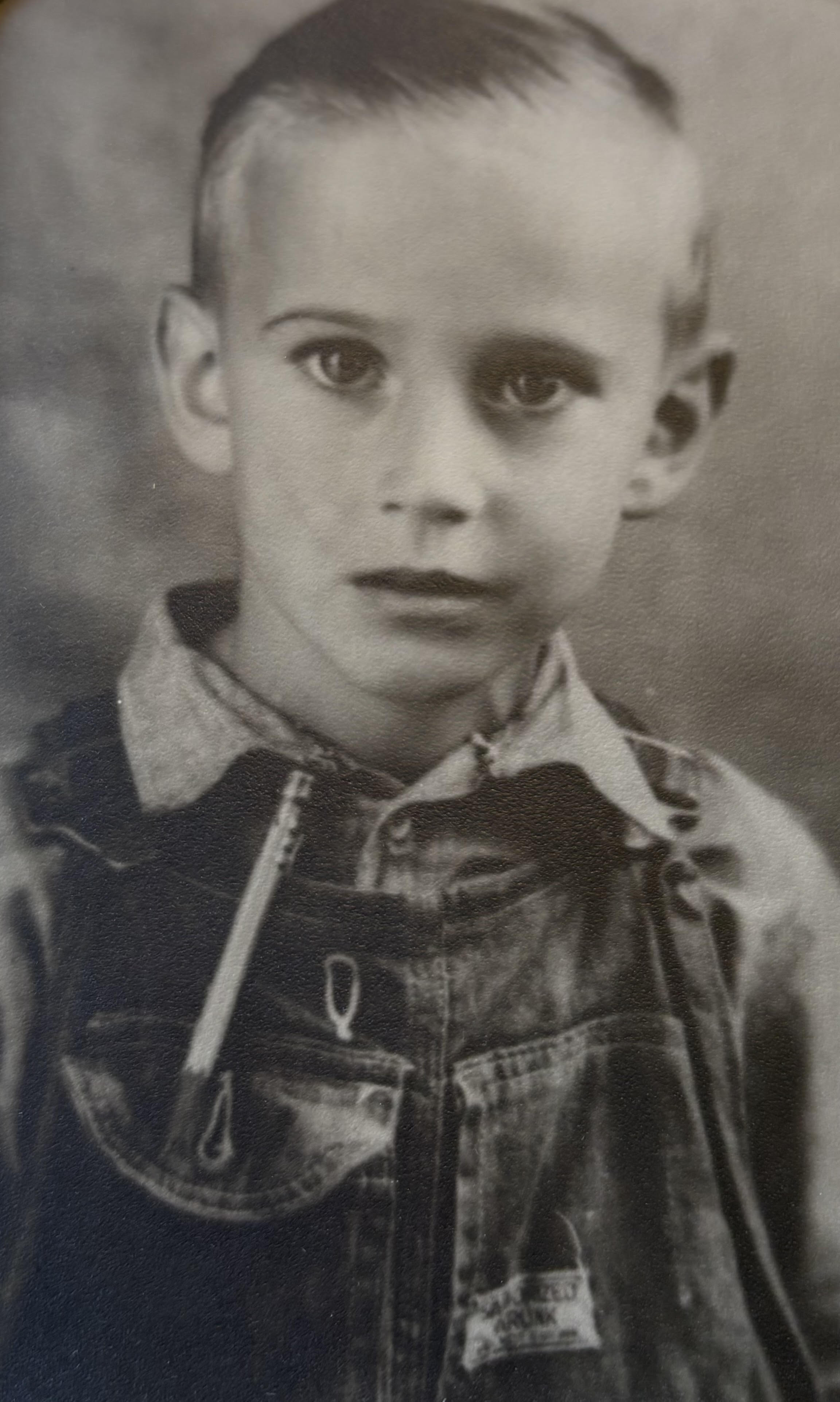
Take a close look at this photograph. A very close look. What do you see? A cute little boy? He was born at a dark time—1933—during the Great Depression. I believe he was eight-years-old in this photo.
Notice the gentle innocence in his eyes? Do they hold anticipation—or apprehension? How about the bib overalls—do they hint at fashion—or poverty? Did you spot the pencil in his breast pocket? Maybe this is a school photo, or he loved to use his imagination and write stories. And the smile—is it tentative or not a smile at all? This picture was taken around 1941.
But why should you care about this little boy?
After all, you didn’t know him? I didn’t “know” him either. The difference is—I knew about him. May I introduce you to Donavan Eugene Magruder, my uncle? He was my father’s younger brother.
In the South, my family often called their sons by their middle names. Donavan was called Eugene, or Gene for short. He was a good little boy. My father once told me my grandparents took Gene to see a doctor in a town nearby their home in Leonard, Missouri, when he suffered from severe headaches. The physician’s one-sentence diagnosis was callous. Zero compassion. “The problem with this boy is that he complains too much.”
Within a year, Gene went blind. Later, a physician in a larger city would diagnose a brain tumor, and Donavan Eugene Magruder would succumb before turning ten—about a year after this picture was taken. It was 1942. The country was in the grip of war.
I don’t have many details of my uncle’s life—or death. My father didn’t talk about it much, which may have been a way of coping with, rather than confronting, a family tragedy. All I know is that my dad had lost his kid brother when he was away at war in the South Pacific, and he used his military salary to help my grandparents pay for the funeral. Not sure if he made it home for the burial.
“When I approach a child, he inspires in me two sentiments: tenderness for what he is, and respect for what he may become.”
Louis Pasteur
You might me wondering, “Why am I telling you this?”
Fair question. A reader once asked me, “Why do you write about your family?” It’s simple, really. I write about my family to inspire you to think more about yours. Your family is a gift. So is mine. Warts and all.
Richard Paul Evans, #1 New York Times bestselling author of The Christmas Box, once said, “Every now and then we find that one book that reaches us deep inside and introduces us to ourselves. And in someone else’s story, we come to understand our own.” It’s also true that by sharing your life experiences, people may come to better understand their own. So, I write about my life experiences in hopes they will “shed light” on yours.
And that brings me back to this young boy.
When I look into his eyes, I not only see innocence. I see—and feel—something more. Lost potential. I have often asked myself what he would have been like? What would he have loved as a child? What would be like as an adult? An uncle? Would he be a person of high integrity like my grandfather, father, Uncle Carl, and his siblings?
Would he farm the land like his father? Become a cost accounting manager at a major auto manufacturer like my father? A quality control supervisor at Boeing like Uncle Carl? Carl approved the final inspection of the Lunar Roving Vehicle (LRV--or "Moon Buggy") for the Apollo 15 moon landing. Would Uncle Gene have the same spark and spirit of optimism of his sister--Aunt Mildred? The dry humor of his nephew, Roger? The kindness and advanced education of his niece, Vicki? Would this “little shaver” have married one day? What would my aunt and first cousins have been like? Would he love to write—like I do? (After all, that’s a pretty big pencil in his pocket.)
So, what can we learn from Donavan Eugene Magruder, who never got a chance to comprehend the word “potential,” much less achieve it?
I believe his life was in God’s hands from the beginning, but the brevity of it got me thinking about how important it is to inspire others to reach their potential. And that’s where it all comes back to you—and me.
Is there someone in your family whom you can encourage to achieve their full potential? Perhaps someone younger than you is still trying to figure out who they are, what they want, what career they should pursue, or how they can find their place in the world.
Funny, isn’t it—although I never met the boy in this photograph, his life has still touched mine—and inspires me to make a difference in the lives of others.
Not a bad legacy—for a nine-year-old.
###
SOMETHING TO CHEW ON: Take a moment to think about members of your family. Who needs your encouragement or inspiration today? What will you be most remembered for in your family—what you accomplished—or what you inspired someone else to accomplish?
NOTE: You can now read any past issue of this Pause More. Rush Less. newsletter under the BLOG tab on my author website. Jamescmagruder.com. Leave a comment on the CONTACT tab or email me directly at: jamescmagruder@gmail.com.
Please SHARE this newsletter with anyone you think would enjoy it. You can subscribe to PAUSE MORE. RUSH LESS. on my website.
